After 30 Years Building Systems, I Can Tell You: Most Businesses Are Invisible to AI — and Don't Know It
Most business owners do not know whether AI can recommend them — and the answer may already be costing them customers.
By Curtiss Witt · The Black Friday Agency · June 22, 2026
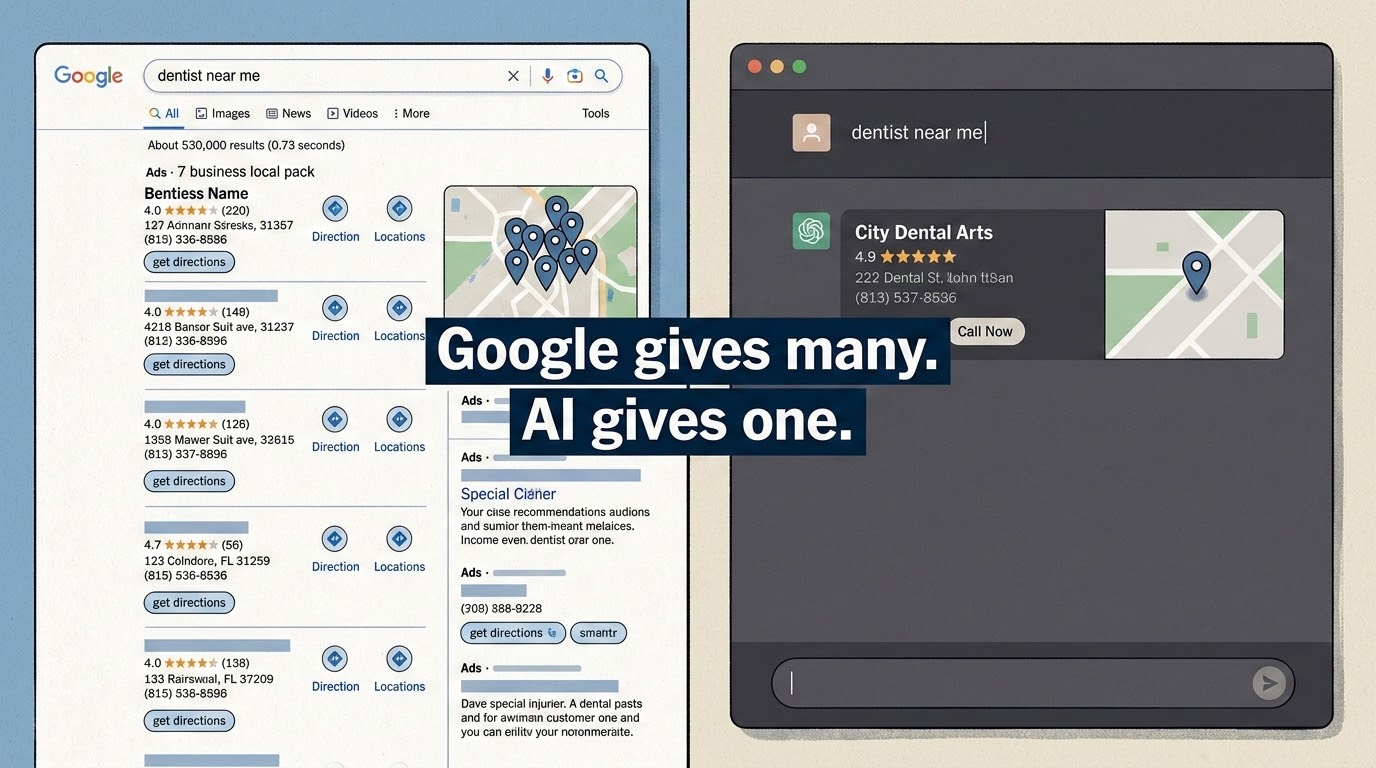
SOCi's local AI visibility research found that ChatGPT recommended only 1.2 percent of local business locations — compared with 35.9 percent appearing in Google's local 3-pack. Read that again. Nearly 36 out of 100 local businesses showed up in Google results. Roughly one out of a hundred showed up when someone asked ChatGPT. That gap is not a glitch. It is the new reality of how customers discover and choose businesses.
If you are a small or midsize business owner, that number should stop you. Not because AI is guaranteed to send you customers. Not because ChatGPT is replacing Google tomorrow. But because the gap between Google visibility and AI recommendation visibility is real, it is already open, and most business owners do not know which side they are on.
The Question Most Owners Have Never Thought to Ask
Most business owners think about marketing in terms of one question: Can people find me? They build websites, claim their Google Business Profile, maybe run some ads. If they show up in local search results, they feel reasonably confident their marketing is working.
But a second question has arrived, and it is just as important: When someone asks AI who to hire, call, or trust for what I do — does my name come up?
These are not the same question. Ranking on Google does not mean being recommended by AI. A business can have a solid Google presence and still be completely absent when a potential customer asks ChatGPT, Gemini, or Perplexity for a recommendation. This is not about whether a business is good. It is about whether AI can understand that it is good, verify that it is trustworthy, and feel confident naming it.
That is a different problem than traditional search — and it requires a different kind of thinking.
What Thirty Years of Systems Thinking Taught Me About This
I spent three decades at Boeing working on complex systems — innovation, organizational effectiveness, process improvement. One of the most consistent lessons I took from that work is that confusion is expensive. When a system cannot quickly identify, verify, and trust a component, it either slows down or routes around it entirely.
That same principle is now playing out inside AI. When a business's public information is unclear, scattered, outdated, or impossible to verify, AI systems do not give it the benefit of the doubt. They find another option. The business is not penalized because it is bad. It is passed over because it is unclear.
After years of watching large organizations lose competitive ground — not because of capability failures but because of communication failures — I recognize this pattern immediately. The businesses that will win the AI era are not necessarily the best businesses. They will be the most understandable ones. That is why we built the AI Recommendation Readiness Audit.
What Most Business Owners Get Wrong
The most common mistake I see is this: a business owner hears about AI search, checks their Google rankings, sees they are doing fine, and concludes the whole thing does not apply to them. What they are missing is that AI recommendation systems work differently than search engines.
A search engine gives ten blue links. It can afford to include your business even if the information is a little thin. AI systems behave more like a careful advisor. They look at everything available — your website, your Google Business Profile, your reviews, third-party mentions, directories, and public facts — and they ask themselves whether they can confidently stand behind this recommendation. If the answer is uncertain, they move on.
BrightLocal's 2026 Local Consumer Review Survey found that use of generative AI tools for local business recommendations rose from 6 percent to 45 percent in a single year — making AI the third most popular source for local business recommendations. That kind of growth does not happen gradually. It happens all at once, and businesses that are not prepared simply miss the moment.
How Selective AI Recommendation Really Is
Source: SOCi 2026 Local Visibility Index — ~350,000 locations across 2,751 multi-location brands. Only ~45% of brands winning Google also appear in AI recommendations.
Why AI Works Like a Cautious Advisor, Not a Search Engine
In the CCA 2.0 framework, we describe the first building block of AI recommendation readiness as Identity Clarity. Before anything else, AI needs to understand clearly and quickly who you are, what you do, where you do it, and who you serve. Not in the vague, slogan-heavy language that fills most small business websites — in plain, verifiable, structured facts.
Think of it this way. If a knowledgeable friend asked you to recommend a good family law attorney in your city, you would not recommend someone based on a vague brochure. You would recommend someone whose reputation you could verify — credentials you had seen, reviews you had read, a clear sense of what they do and for whom. AI works the same way. It is looking for a business it can confidently vouch for.
When that clarity is missing — when the website is vague, the reviews are thin, the business facts are inconsistent, or the proof is absent — the business pays what we call the Trust Tax. The Trust Tax is the hidden cost of unclear, unstructured, or unverifiable business information. It does not show up on a spreadsheet. It shows up in recommendations that go to someone else.
The good news is that this is fixable. SOCi found that AI draws 58 percent of its local answers from business websites, 27 percent from mentions, and 15 percent from directories. Most of those signals are within a business owner's direct control.
Where to Start
- 1.Ask AI about your business right now. Open ChatGPT, Gemini, and Perplexity. Ask each one who the best option is for what you do in your area. See if your name comes up, and if it does, read what it says. You may be surprised — or concerned — by the answer.
- 2.Check your Identity Clarity. Can a stranger understand what you do, where you do it, who you serve, and why you are trustworthy in the first ten seconds of reading your website? If the answer is no, AI cannot answer that question either.
- 3.Audit your business facts across platforms. Your business name, category, address, phone number, hours, and services should say the same thing on your website, your Google Business Profile, your directories, and any other public listing. SOCi found only 68 percent of business contact information on ChatGPT and Perplexity matched the Google Business Profile — a third of businesses are feeding AI conflicting data.
- 4.Look at your reviews honestly. Not just the star rating, but the volume, the recency, and what they actually say. BrightLocal found that 82 percent of consumers read AI-generated review summaries. If your reviews are stale, thin, or missing, that weakness shows up in AI answers.
- 5.Identify the questions your customers ask before they call you. If your website and content do not address those questions directly, AI has no material to work with when someone asks it to recommend you.
This Is Fixable — But the Window Is Open Now
The shift toward AI-mediated discovery is real, but it is not a catastrophe for small businesses that act early. Most large brands are not yet well-positioned for AI recommendation either. The businesses that will benefit are the ones that become clearer, more consistent, more verified, and more useful — before their competitors do.
What AI needs is not a bigger marketing budget. It needs to understand what you do, trust that you do it well, and find enough public proof to feel confident recommending you. Most of that is within your control.
The window to act is open. The businesses building trust infrastructure now will be the default AI answers later. The ones that wait will find that someone else already owns that position.
Frequently Asked Questions
What does it mean for AI to recommend my business?
When someone asks ChatGPT, Gemini, Perplexity, or a similar AI tool who to hire or call for a service in your area, AI recommendation readiness determines whether your business is named. Unlike traditional search, which returns many links, AI typically names only a few options — sometimes just one. Whether your business is among them depends on how clearly and verifiably your information is presented across the web.
If I rank well on Google, doesn't that mean AI will recommend me?
Not necessarily. SOCi's local AI visibility research found that only about 45 percent of businesses that win Google's local 3-pack also appear in AI recommendations. Ranking on Google and being recommended by AI are related but separate outcomes. AI systems evaluate clarity, consistency, trust signals, and verifiable proof — not just search rank.
What is the Trust Tax?
The Trust Tax is the hidden cost of having unclear, inconsistent, vague, or unverifiable business information online. When AI systems cannot confidently verify what a business does, who it serves, or why it should be trusted, they may skip it and recommend a competitor instead. The Trust Tax does not appear on a balance sheet — it shows up as missed recommendations.
How fast is AI being used for local business recommendations?
According to BrightLocal's 2026 Local Consumer Review Survey, use of ChatGPT and other generative AI tools for local recommendations rose from 6 percent to 45 percent in a single year — making it the third most popular source for local business recommendations. That kind of growth means the shift is not gradual. Businesses that are not ready will miss customer decisions that have already moved into AI.
What is the AI Recommendation Readiness Audit?
The AI Recommendation Readiness Audit is a diagnostic tool developed by The Black Friday Agency that evaluates a business across eight readiness categories: Identity Clarity, Trust Foundation, Money Dialog Coverage, Hub of Truth Readiness, Authority and Citation Signals, Conversion Path Clarity, AI Usability, and Sponsored Readiness. It shows whether AI can confidently recommend your business today, where the gaps are, and what to fix first. Take the audit here.
Sources & Citations
SOCi 2026 Local Visibility Index
Analysis of approximately 350,000 local business locations across 2,751 multi-location brands. Found ChatGPT recommended 1.2% of locations, Gemini 11%, Perplexity 7.4%, versus 35.9% in Google's local 3-pack. Approximately 45% of brands winning Google also appeared in AI recommendations.
BrightLocal 2026 Local Consumer Review Survey
Survey of 1,002 US adults. Found AI tool use for local business recommendations rose from 6% to 45% in one year. Also found 97% of consumers read reviews, 82% read AI-generated review summaries, and 40% trust AI platforms for business recommendations.
U.S. Chamber of Commerce
Reported 58% of small businesses now use generative AI, up from 40% in 2024.
CCA 2.0 Research — The Black Friday Agency
Primary research foundation for the AI Recommendation Readiness Audit scoring model, Trust Tax framework, Identity Clarity categories, and Money Dialog definitions. June 2026.